

Getting a mortgage after bankruptcy
It is possible to get a mortgage after bankruptcy. Most people are eligible after 12 months, and options improve significantly after 2–3 years! But, your credit history isn’t your whole story.
See how much you could borrow, only takes a few minutes, NO CREDIT CHECKS!

Table of contents
19 minutes
Updated: September 25th, 2026
Mortgages after Bankruptcy: What you need to know
Can I get a mortgage after bankruptcy?
Yes. You are not blacklisted for life. While most high-street banks will decline you automatically, specialist lenders look at your current affordability and the reasons behind your past financial difficulties. You are generally eligible to apply the day after your bankruptcy is officially discharged (usually 12 months after it began).
How much deposit will I need?
The cost of getting a mortgage after bankruptcy is usually a higher deposit. While a standard buyer might need 5%, you should aim for the following benchmarks based on your discharge date:
- 1 year post-discharge: 25–30% deposit
- 3 years post-discharge: 15–20% deposit
- 6 years post-discharge: 5–10% deposit
Why use a specialist broker instead of my bank?
High-street banks use automated tick-box systems that trigger an instant rejection for bankruptcy. Specialist lenders use manual underwriting, meaning a real person reviews your application. They prioritise your conduct since the discharge, showing that you’ve managed your bills perfectly since the bankruptcy is often more important than the bankruptcy itself.
What credit score do I need after bankruptcy?
In the UK, there is no single “magic number” that guarantees a mortgage approval. Lenders don’t just look at your score; they look at your full credit report. While your score will naturally be lower after bankruptcy, lenders are more interested in stability.
Using the 2026 updated brackets, here is where most people sit after bankruptcy:
| Rating | Experian | TransUnion | Equifax |
|---|---|---|---|
| Low | 0–640 | 0–550 | 0–438 |
| Poor | 641–860 | 551–565 | 439–530 |
| Fair | 861–1,000 | 566–603 | 531–670 |
| Good | 1,001–1,120 | 604–627 | 671–810 |
| Excellent | 1,121–1,250 | 628–710 | 811–1,000 |
Even if your score is in the “Poor” bracket, you could still get a mortgage. Specialist lenders care less about the points and more about whether you have had any new defaults or missed payments since your discharge.
How much could you borrow after bankruptcy?
Fill out a few details to see if you are eligible for a mortgage after bankruptcy with NO effect on your credit score!
Prefer to speak with an expert? Call our team directly on 0330 094 5876 or request a call back today.
Mortgage documents: Your post-bankruptcy checklist
To give your application the best chance of success, specialist underwriters will need to see a clear “trail of stability” following your discharge. Use this checklist to gather your documents before you apply:
- Official Certificate of Discharge: This is the most critical document. It proves you are no longer under the legal restrictions of bankruptcy.
- 12 months of “clean” bank statements: Lenders will scrutinise these for any returned direct debits, overdrawn periods, or gambling transactions. They want to see perfect financial conduct.
- Proof of Electoral Roll registration: Essential for verifying your identity and address history without relying solely on a credit score.
- Most recent P60 and 3 months of payslips: If you are self-employed, you will typically need 1–2 years of SA302 tax calculations and overviews.
- Latest credit report (Multi-Agency): Having a current copy of your report from all three main agencies (Experian, Equifax, and TransUnion) allows your broker to spot any incorrectly marked defaults before the lender does.
- Proof of deposit: You will need to show where your deposit has come from (e.g., savings or a gifted deposit from a family member).
Your timeline to homeownership
Getting a mortgage after bankruptcy is about the time elapsed since your discharge date. Use this guide to see which lenders and terms are currently available to you in 2026.
0–12 months: The waiting period
- Status: Undischarged.
- Lender Type: None.
- Typical Deposit: N/A.
- While you’re an “undischarged bankrupt”, you are legally restricted from taking out significant credit. No UK lender will consider a mortgage application during this window. This year is best spent saving and ensuring every single bill (utilities, mobile) is paid on time via Direct Debit to start your “clean slate” history.
12–36 months: Specialist entry
- Status: Discharged (recently).
- Lender Type: Specialist Adverse Lenders.
- Typical Deposit: 25–30%.
- You may now be eligible to apply. You won’t find these deals on a price comparison site or at a high-street branch; they are only accessible through specialist brokers. Expect higher interest rates to offset the lender’s risk.
3–6 years: Growing choice
- Status: Discharged (established).
- Lender Type: Wide range of Specialist & some Mid-tier Lenders.
- Typical Deposit: 15–20%.
- By this stage, the bankruptcy is becoming “historic”. If you have maintained a flawless credit record since discharge, more lenders will compete for your business. You may even see some high-street brands start to consider you, provided your deposit is large enough.
6+ years: Mainstream recovery
- Status: Bankruptcy removed from credit file.
- Lender Type: Full market (High Street & Specialist).
- Typical Deposit: 5–10%.
- At this milestone, the bankruptcy record is typically removed from your credit reports (Experian, Equifax, TransUnion). You can now access standard “High Street” rates and low-deposit schemes.
- Note: You must still answer “Yes” if a lender specifically asks if you have ever been bankrupt, but at this stage, it rarely results in an automatic decline.
Specialist vs. high-street lenders: Comparing your options
Most borrowers are familiar with high-street banks, but following a bankruptcy, the “hidden” market of specialist lenders often provides the only viable path to a mortgage.
| Feature | Specialist Lenders | High-Street Banks |
|---|---|---|
| Access & speed | Usually only available via professional brokers; manual review can take longer. | Direct access via branches/apps; automated systems give “instant” decisions. |
| Rates & deposits | Higher interest rates and larger deposits (typically 15%+) to offset risk. | Lower, “market-leading” rates and smaller deposits (5–10% potentially). |
| Criteria flexibility | High. They look at the reason for your bankruptcy and your conduct since discharge. | Low. Most use “hard-stop” rules that auto-decline any history of bankruptcy. |
| Best suited for | Recent discharges (1–5 years) or those with complex credit files. | Historic bankruptcies (6+ years) with a now-perfect credit score. |
Know your mortgage potential
Your credit isn’t your whole history.
No credit checks and only takes a few minutes!

Why full disclosure is your best strategy
Many borrowers believe that once a bankruptcy drops off their credit file after six years, they no longer need to mention it. However, the UK mortgage process involves more than just a standard credit score check.
The “final check” before completion
Lenders often perform a secondary sweep of your data at the mortgage offer or completion stage using the National Hunter database. This is a cross-industry system where UK lenders share application data to spot inconsistencies.
- The mismatch risk: If you tell a lender you have “never been bankrupt,” but a previous application on the National Hunter database (even from 10 years ago) shows otherwise, the lender may withdraw your offer immediately.
- Misinterpretation vs. fraud: In the eyes of a bank, failing to disclose a past bankruptcy, even an old one, can be flagged as “misrepresentation.” This can lead to a declined application and a potential fraud marker that makes future borrowing even harder.
Protecting your offer
The simplest way to avoid a last-minute rejection is total transparency from day one. By disclosing your full history to your broker, they can:
- Identify lenders whose criteria specifically ignore bankruptcies older than six years.
- Ensure your application is presented accurately so that no “red flags” are raised during the final audit.
- Navigate the “Have you ever…” question without risking your deposit or your house move.
How to rebuild your credit and improve your chances
Rebuilding your credit isn’t about getting a high score overnight; it’s about proving to a future lender that you are a safe bet now.
Register on the Electoral Roll
This is the simplest way to boost your score and help lenders verify your identity instantly.
Audit your credit reports for accuracy
It is common for debts included in a bankruptcy to be incorrectly marked as “active” or “defaulted” after your discharge. Ensure all included accounts are updated to show as “Satisfied” or “Settled” with a zero balance. If they aren’t, you must dispute them with the credit reference agencies to prevent them from appearing as fresh defaults.
Demonstrate responsible credit use
To prove you are a safe bet, you need to show you can handle credit again. Using a credit-builder card for small, regular purchases and paying the balance in full via direct debit creates a consistent pattern of positive data on your file.
Maintain a flawless payment history
Since your discharge date, your record must be spotless. Even a single late payment on a utility bill or mobile phone contract can lead a specialist lender to decline an application, as it suggests a recurring pattern of financial difficulty.
Manage your "hard searches"
Avoid applying for multiple lines of credit (loans, store cards, or car finance) in a short window. Each “hard” credit check remains on your file for 12 months and can signal to a mortgage lender that you are overly reliant on credit.
Accessing specialist lenders
Many specialist lenders who accept discharged bankrupts do not deal directly with the public. These are “intermediary-only” lenders, meaning they only accept applications through a qualified mortgage broker. Because the specialist market changes its criteria frequently, a broker can identify which specific lender is most likely to accept your application based on your discharge date and current deposit.
What interest rates should you expect as a discharged bankrupt?
It is important to be realistic. You will likely pay a higher interest rate than a borrower with a perfect credit score. Lenders view a recent bankruptcy as a higher risk, and they price their mortgages accordingly.
- The adverse premium: Specialist rates for discharged bankrupts are typically 2–4% higher than standard high-street deals.
- In 2026: With the current average 2-year fix sitting around 5% for standard buyers, a post-bankruptcy borrower should expect initial rates in the 7% to 9% range, depending on the size of their deposit.
- Total cost of borrowing: Don’t just look at the rate. Specialist products often come with higher arrangement fees. A slightly higher rate with a lower fee can sometimes be more cost-effective over a 2-year period.
- The repair strategy: Most of our clients take a 2-year fixed deal. This gives you 24 months of perfect conduct to rebuild your credit score, allowing you to remortgage onto a cheaper, standard rate once that initial period ends.
Remortgaging after bankruptcy
If you already own a home, remortgaging after bankruptcy follows the same logic as a new purchase. The key hurdles are your discharge date and the amount of equity currently held in your property.
Can I remortgage to get a better rate?
While you are in an active bankruptcy period, remortgaging is generally not an option. Once you are discharged (usually after 12 months), specialist lenders will consider your application. You will typically require a significant amount of equity, often 25% or more, and should expect higher interest rates initially. Your access to high street rates usually returns 3–4 years post-discharge, provided your credit conduct has been flawless.
Can I remortgage to pay off my bankruptcy (annulment)?
An annulment effectively cancels the bankruptcy order as if it never happened. This is a complex area of finance.
- During active bankruptcy: Standard lenders will not help. You would typically need a specialist “second charge” or “annulment finance” lender. These are high-cost products only accessible via a specialist broker.
- Post-discharge: Securing a remortgage specifically to settle debts from the bankruptcy remains challenging. Lenders will require substantial equity in the property to mitigate the risk.
Why work with a specialist fee-charging broker?
Specialist mortgages after bankruptcy require a dedicated advocate, not just an automated search. While “fee-free” brokers often focus on “perfect” applicants, we provide access to lenders where our expertise turns a “no” into a “yes.”
- Free initial consultation: We review your bankruptcy discharge and financial conduct at our own risk. We never charge a fee just to discuss your options.
- We prove our value first: Our fee is only payable once you decide to move forward with an application. We invest the time upfront to manually package your case for an underwriter to ensure the highest probability of success.
- The long-term goal: Think of a specialist mortgage as a “stepping stone.” By securing your home now and maintaining perfect payments, we can aim to move you to a cheaper, high-street rate in the future.
Find out your credit score today!
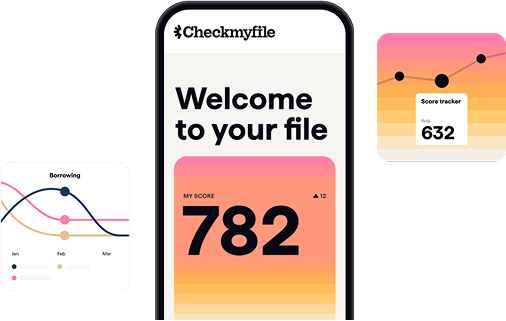
Lenders rarely look at just one score; they compare data across multiple agencies. To get the most accurate picture of your mortgage options, we recommend viewing your multi-agency report from Checkmyfile. Start your 7-day FREE trial today (£14.99/month after trial, cancel anytime).
We may earn a small commission from some links on this page, but we only recommend services we genuinely trust to help our clients.
FAQs: Getting a mortgage after bankruptcy
Yes. Combining adverse credit with Buy-to-Let is a specialist area, but it is often more straightforward than a residential application. Lenders prioritise the property’s anticipated rental income over your personal finances. You will, however, need a larger deposit, typically 25–30% of the property’s value. A spotless credit record since your discharge will significantly increase your chances of approval.
If you are declined, do not immediately reapply elsewhere. Every hard search is recorded and can further damage your credit score. Instead, work with a broker to identify the specific reason for the rejection, whether it was an affordability issue, a “hard-stop” on your bankruptcy date, or a documentation error. We can then retarget your application toward a lender whose criteria you actually meet.
A partner’s stable income and clean history will certainly help with overall affordability and proof of stability. However, the lender’s primary risk assessment will still be driven by the applicant with the bankruptcy history.
Yes. Many specialist lenders are happy to support Right to Buy applications for discharged bankrupts, often allowing you to use the council property discount as the deposit for the mortgage.
Often, yes. Many lenders view a business failure more sympathetically than personal overspending. If you can provide a clear explanation of the circumstances, you may find more flexibility in the rates and terms offered.
Specialist mortgages often carry higher arrangement fees (typically 1–2% of the loan amount) compared to standard deals. We provide a full total cost breakdown so you can see exactly how the fees and interest rates compare over the life of the fixed term.
About the author

Phil Scott: Director
Phil Scott is the Founder and Managing Director of The Mortgage Centres, one of the UK’s leading independent, whole-of-market mortgage brokerages. With over 30 years of experience and a network of specialist branches, Phil has built a firm defined by manual advocacy and comprehensive market access.
Under his leadership, The Mortgage Centres provides high-touch advisory services for the full spectrum of UK borrowers – from standard residential moves for first-time buyers to complex specialist lending for portfolio landlords. Phil’s institutional approach ensures that every client receives a level of scrutiny and lender access that automated platforms cannot match.
Qualifications:
- FCA Regulated: Leading compliant, high-trust advice since 1992.
- Financial Planning Certificate: 1, 2 & 3 | Year Attained: 1992
- Certificate in Mortgage Advice and Practice (CEMAP) | Year Attained: 2001
Let's talk
Our team will aim to get back to you within 24 hours.
0330 0945876 local rate.
[email protected]
"*" indicates required fields