

Getting a mortgage with a DMP
It is possible to get a mortgage or remortgage with a Debt Management Plan (DMP). Specialist lenders may consider you, even with an active plan.
Your credit history isn’t your whole story.
See how much you could borrow, only takes a few minutes, NO CREDIT CHECKS!

Table of contents
21 minutes
Updated: January 28th, 2026
DMP Mortgages: What you need to know
- Can I get a mortgage or remortgage with a DMP? Yes is may be possible. While high-street banks
may decline you, specialist lenders regularly approve mortgages for those with both active and
settled Debt Management Plans. - How much deposit will I need? Expect to need between 15% and 25% if your DMP is currently active.
If your DMP has been settled for over 3 years, you may be able to secure a mortgage with as little as a
10% deposit. - How can I improve my chances? You can strengthen your application by providing 12 months of on-time
DMP payments, ensuring zero gambling or overdraft usage on your bank statements for the last
6 months, and using a specialist broker to access lenders who do not use automated credit scoring.
Can I get a mortgage with a DMP?
Applying for a mortgage while on a debt management plan can be challenging, but specialist lenders are available to help. They consider various factors like income, outgoings, and credit history when assessing an application for a mortgage with a DMP.
The severity and recency of credit issues impact your approval chances. In all cases, the more severe and recent a credit event is, the more negative weight it will carry. So, for example, getting a mortgage after a CCJ that occurred 3 months ago will be a lot more difficult than if you had a few missed payments on a phone bill 2 years ago.
A debt management plan shows a willingness to clear debts, which can be a positive factor.
Getting a mortgage after a settled DMP
Like all other adverse credit issues, a DMP will stay on your credit record for six years, whether settled or not. It may make it harder to get a mortgage, but it’s easier if the DMP is settled.
To improve your chances of getting a mortgage after settling a DMP, check your credit reports for accuracy. If any information is incorrect, contact the company responsible and ask them to update the status. They are not obliged to, but if they do it will be a great help.
Make sure to copy the letter to the main debt reference agencies – TransUnion, Equifax and Experian . Finally, you could consider taking out a credit card to rebuild your credit score by making timely payments and staying within your budget.
Remortgaging with a DMP
It is also possible to remortgage with a DMP. Getting a remortgage with a DMP can help clear outstanding debts, but lenders will still assess you based on their criteria.
Typically, they will require you to retain between 5-15% equity in the property value to remortgage depending on individual circumstances.
If your property has not increased in value or you have a high loan-to-value ratio, lenders may decline your
application.
How much deposit will I need?
A larger deposit, typically between 5% and 15%, is highly likely to be required if you are currently in a Debt Management Plan (DMP) or have recently completed one.
This deposit size depends heavily on your individual circumstances, including: the duration of your DMP, your payment history within the plan, the amount of debt involved, and any other credit issues. For applicants with a significant adverse credit record, you may be required to provide a deposit at the higher end of this range, or even more.
Your credit history will also affect your Loan-to-Value (LTV) ratio. With an active or past DMP, lending is often restricted to 85% LTV if you have a history of defaults or CCJs (County Court Judgements), which reinforces the need for a minimum 15% deposit.
For example, if you want to get a mortgage with a DMP on a property valued at £300,000, with an 85% LTV, you would need to borrow £255,000.
Deposit requirements based on your DMP status
Lenders categorise risk primarily by when your DMP was settled. Generally, the longer the time elapsed since the DMP was settled, the more favourable the terms are likely to be.
| DMP Status | Typical Deposit Required (LTV) | Typical Lender Type | Risk Profile |
|---|---|---|---|
| Active DMP | 25% – 30% (70-75% LTV) | Highly Specialist / Sub-Prime | Highest Risk |
| Settled 0-3 Years Ago | 15% – 20% (80-85% LTV) | Specialist | Medium Risk |
| Settled 3+ Years Ago | 10% (90% LTV) | Near-Prime / Mainstream | Lower Risk |
These are typical guidelines. Other factors, such as your credit score before the DMP and the total value of the original debt, may also affect the final rate offered.
How can I improve my chances and what will the terms be?
Specialist DMP mortgage lenders Using a mortgage broker for getting a mortgage with a DMP, can help you access specialist lenders who are more flexible with their lending criteria. Some of these lenders are not accessible to the public and can only be accessed through brokers or intermediaries.
These specialist lenders adopt a more flexible view of your finances than traditional high street lenders and will consider your overall circumstances rather than just your credit score. They may be willing to lend to someone with a past DMP, but interest rates may be higher, and a larger deposit may be required.
If you want to know more about your options for obtaining a mortgage while you have a DMP on your file, don’t
hesitate to get in touch with our team today and arrange a free, no-obligation initial consultation.
Preparing your application
To give yourself the best chance of approval and access to better rates, focus on presenting a clean, stable profile and submitting a complete package of documents. Use the checklists below to manage your journey through preparing your mortgage application with a DMP:
1. Strategic stability and control
- Provide a detailed DMP history: Don’t just mention the DMP; provide a full, detailed statement. Include why the debts were incurred, why the DMP was necessary, and, crucially, confirm you have maintained 100% on-time payments since the plan began.
- Show proof of control: Underwriters look for stability. They prefer applicants who have not incurred any new credit since the DMP started and who have maintained a clean payment record across all other commitments (rent, utilities, phone bills).
- Demonstrate affordability with a buffer: Provide detailed income and expenditure showing that you can comfortably afford the proposed mortgage payments, and that you have a financial buffer remaining each month.
2. Mandatory documents checklist
You must provide these non-standard documents to satisfy the underwriter, proving the history and status of your plan:
- The full original DMP agreement: Required to verify the official start date and initial terms of your plan.
- Last 12 months of payment statements: Clearly show 12 consecutive months of on-time, full payments to the DMP provider.
- A letter of explanation (L.O.E.): A formal letter explaining the cause of the DMP and detailing the positive steps you have taken to maintain stability since the plan started.
3. Essential financial conduct (Last 3-6 Months)
Lenders scrutinise your recent banking habits for signs of ongoing risk:
- Clean bank account conduct: Zero unauthorised overdrafts, missed payments, or bounced direct debits.
- No gambling transactions: Any evidence of regular or large gambling activity is a major red flag and may lead to an immediate decline.
- Use a specialist broker: The highest level of assurance for an underwriter is an application submitted by a specialist broker. This signals that the application has already been rigorously vetted against the specific lending criteria of adverse credit lenders.
Should you pay off your debts or save a bigger deposit?
One of the most complex strategic decisions you face is whether to use spare capital to settle your Debt Management Plan (DMP) early, or to keep saving for a larger mortgage deposit. The right answer depends on your long-term goals and must be modelled by a specialist broker.
| Strategy | Pro-Deposit (Save for a Bigger Deposit) | Pro-Pay-Off (Settle the DMP Early) |
|---|---|---|
| Primary Goal | Reduces the Loan-to-Value (LTV) ratio. | Improves your credit rating and score faster. |
| Benefit | Opens up a wider choice of specialist lenders immediately and usually grants access to lower interest rates due to the lower risk profile. | Reduces the total debt burden, which significantly improves your affordability check (Debt-to-Income ratio). |
| Risk/Caveat | Your total debt burden remains high, which may cause some lenders to reject the application on affordability grounds, even with a big deposit. | You have less capital, forcing you to accept a higher LTV (and potentially a higher interest rate) with fewer lenders. |
A specialist mortgage advisor will be best placed to tell you what to choose according to your specific circumstances.
Find out how much you could borrow
Your credit history isn’t your whole story. See how much you could borrow for a mortgage with a DMP. No credit checks and only takes a few minutes!

Remortgaging vs. Second Charge: Homeowners
If you already own your property, the best path forward may not always be a full remortgage if you have a DMP. A specialist broker needs to model the benefits of a full remortgage against a second charge/secured loan.
| Strategy | Full Remortgage | Second Charge / Secured Loan |
|---|---|---|
| Best Used When | Your current lender won’t allow a further advance, or your current mortgage deal has ended. | You have a low-rate first mortgage you don’t want to disturb, or you have Early Repayment Charges (ERCs). |
| Primary Benefit | Consolidates all debt into one, single monthly payment. | Leaves your main, low-rate mortgage untouched, protecting your existing deal on the bulk of your borrowing. |
| Risk/Caveat | You may lose your low-rate deal on the entire mortgage balance and may trigger significant ERCs. | The interest rate on the Secured Loan may be higher than your main mortgage. |
The choice between remortgaging everything and using a second charge/secured loan is critical.
For instance, if a broker’s advice saves you just 0.5% on your existing £300,000 mortgage balance by preventing you from switching deals unnecessarily, this decision alone could save you over £15,000 in total interest repayments over the life of your mortgage.
A specialist broker guides you to the most suitable overall deal, saving you money in repayments over the life of your mortgage.
Specialist DMP mortgage lenders
Using a mortgage broker for getting a mortgage with a DMP, can help you access specialist lenders who are more flexible with their lending criteria. Some of these lenders are not accessible to the public and can only be accessed through brokers or intermediaries.
These specialist lenders adopt a more flexible view of your finances than traditional high street lenders and will consider your overall circumstances rather than just your credit score.
They may be willing to lend to someone with a past DMP, but interest rates may be higher, and a larger deposit may be required.
If you want to know more about your options for obtaining a mortgage while you have a DMP on your file, don’t hesitate to get in touch with our team today and arrange a free, no-obligation initial consultation.
Why work with a specialist fee-charging mortgage broker?
At The Mortgage Centres, we believe that non-standard financial situations require more than just an automated search. Our model is built on providing a “complex but cared for” experience that combines national reach with the accountability of local service.
- Success-based commitment: We invest a significant amount of time upfront, at our own risk, to review your situation and provide expert advice. Our fee is only payable once you decide to move forward with a mortgage application, meaning we must prove our value to you first.
- Specialist knowledge over generalism: While many brokers are “jacks-of-all-trades,” our team focuses on the niche corners of the market, such as Adverse Credit and complex incomes. We dedicate the necessary time to manually package your case for an underwriter, ensuring every detail is presented to give you the highest probability of success.
- Local accountability, national access: By charging a fee, we are able to sustain a network of local branches that offer personal, face-to-face or video support, backed by the panel-access and technology of a national firm.
Find out your credit score today!
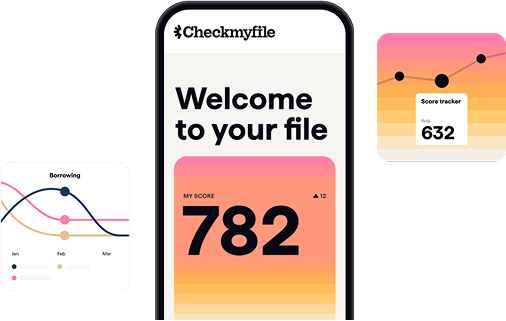
Lenders rarely look at just one score; they compare data across multiple agencies. To get the most accurate picture of your mortgage options, we recommend viewing your multi-agency report from Checkmyfile. Start your 7-day FREE trial today (£14.99/month after trial, cancel anytime).
We may earn a small commission from some links on this page, but we only recommend services we genuinely trust to help our clients.
FAQs: Getting a mortgage with a DMP
A debt management plan (DMP) is a non-formal arrangement to repay debts like mobile contracts, credit cards, and loans. You must still be able to afford essential bills in order to obtain one.
Understanding what a DMP involves is important when considering a mortgage with a DMP.
You will need a DMP practitioner to help manage the plan. Some practitioners are free, while others may charge fees. Some free, well-known, DMP practitioners include StepChange, Payplan and National Debtline.
DMPs are not legally binding and can be cancelled at any time. However, if you fail to meet payments, it will affect your credit score, which can impact your ability to get a mortgage with a DMP.
The DMP itself will not appear on your credit record, but the debts still outstanding will.
Creditors paid through a DMP might put a note to this effect on the report, and the accounts that are still technically in arrears will still show as such until the fall out of the six-year scope of a credit check.
A DMP will also need to be disclosed as part of any mortgage application, no matter the status of debts it covers on your credit file.
While it might seem intuitive to cancel your DMP to remove the label, doing so without an immediate full settlement is highly risky.
Cancelling your plan will cause the debts to default, which is a much more severe negative marker on your credit file than a DMP.
It is almost always better to keep the plan active until you have secured your mortgage offer or have the funds to settle the debts completely.
Getting a mortgage with a DMP will depend on the individual lender’s own criteria, but it is typically 12 months. You’ll probably be asked to put down a bigger deposit and pay a higher interest rate on the loan.
Lenders always look at affordability when making mortgage offers. If you are already paying off other debts, then they will need to know how you will sustain mortgage payments on top of this.
A dilemma might arise if you have managed to save up a decent-sized deposit – should you use this to pay off your DMP and relieve your ongoing commitments, or it is best used as a down-payment on a property?
A specialist mortgage advisor will be best placed to tell you what to choose according to your specific circumstances.
Yes, in the long term. Mortgaging your property to consolidate debts might seem like a scary step, but it often works to your long-term advantage.
The interest rate locked into a mortgage or secured loan is typically lower than the interest rates you might pay on the original unsecured debts (e.g., credit cards or personal loans).
Yes. While a DMP is active, lenders will consider you a higher credit risk, making it harder to get credit (like new credit cards or phone contracts) in the short term.
Yes, this is entirely possible, and usually desirable.
If your cash flow is healthy enough, or you have come into some money you can use, then you can settle the debts and close the DMP.
Also, if you have been in a DMP for six months or more, you are able to make lump-sum offers to your creditors. They may be willing to accept perhaps 50% of the amount owed if they get that cash immediately.
You can do this with one or more of your creditors, depending on what you are able to pay.
About the author

Phil Scott: Director
Phil Scott is the Founder and Managing Director of The Mortgage Centres, one of the UK’s leading independent, whole-of-market mortgage brokerages. With over 30 years of experience and a network of specialist branches, Phil has built a firm defined by manual advocacy and comprehensive market access.
Under his leadership, The Mortgage Centres provides high-touch advisory services for the full spectrum of UK borrowers – from standard residential moves for first-time buyers to complex specialist lending for portfolio landlords. Phil’s institutional approach ensures that every client receives a level of scrutiny and lender access that automated platforms cannot match.
Qualifications:
- FCA Regulated: Leading compliant, high-trust advice since 1992.
- Financial Planning Certificate: 1, 2 & 3 | Year Attained: 1992
- Certificate in Mortgage Advice and Practice (CEMAP) | Year Attained: 2001
Let's talk
Our team will aim to get back to you within 24 hours.
0330 0945876 local rate.
[email protected]
"*" indicates required fields