

Can you get a mortgage with a CCJ?
Yes – getting a mortgage with a CCJ is possible.
But, your credit history isn’t your whole story.
See how much you could borrow for a mortgage with a CCJ, only takes a few minutes, NO CREDIT CHECKS!

Table of contents
13 minutes
Updated: January 28th, 2026
Mortgages with CCJs: What you need to know
Yes – you could get a mortgage with a CCJ.
Here’s what lenders will consider:
- Age of the CCJ: Older judgments are easier to get approved against.
- Whether it’s satisfied: Paid CCJs improve your chances significantly.
- Amount owed: Larger CCJs usually require a bigger deposit or specialist lenders.
How to improve your chances:
- Pay off debts where possible.
- Keep credit utilisation low and accounts in good standing.
- Use a specialist broker to access lenders not available on the high street.
Next steps:
- Check your eligibility with our quick form (no credit check).
- Talk to a broker to explore tailored options for your circumstances.
Did you know?
15% of UK adults have had a CCJ at some point [1], and many successfully secure mortgages each year. While CCJs do affect lender decisions, understanding your credit file and seeking specialist guidance can significantly improve your options.
Expert whole-of-market broker access
Don’t let a CCJ stop you. Our specialist team works with hundreds of people in similar situations every year.
- Whole-of-market access: We’re not tied to any single lender, giving you the widest choice of mortgage options.
- Specialist lenders: Many lenders who consider CCJs aren’t on the high street. We connect you directly.
- Tailored support: We guide you through the process, helping you understand what lenders are looking for and how to improve your chances.
Next step:
Book your free initial consultation to explore your options and speak to a specialist.
Check your eligibility
How much deposit will I need?
When applying for a mortgage with a CCJ, deposit requirements are usually higher than for someone with a clean credit history.
Recent trends show that most new consumer judgments are small-value debts, with 38% under £500 [2]. This suggests many applicants with CCJs may face lower deposit thresholds if the CCJ amount is small.
How much you’ll need depends on:
- CCJ age: Older CCJs generally require smaller deposits.
- CCJ status: Satisfied CCJs improve your chances and may reduce deposit requirements.
- Amount owed: Larger CCJs usually mean a larger deposit.
Typical deposit ranges:
| Time Since CCJ | Typical Deposit Required | Deposit Considerations |
|---|---|---|
| Less than 1 year | 5–10% | Applies whether satisfied or unsatisfied; specialist lenders likely required |
| 2 years | 5–10% | Satisfied CCJs may improve access; unsatisfied may still require specialist lenders |
| 2 years plus | 1–5% | Lower deposits available through specialist lenders; satisfied CCJs improve chances further |
Disclaimer: Lower deposits (1–5%) are only possible through certain specialist lenders and depend on your income, credit profile, and the age/status of your CCJ.
Check your borrowing power
Your credit history isn’t your whole story. Use our free bad credit mortgage calculator to see how much you could borrow.
No credit checks and only takes a few minutes!

Lender criteria: can I get a mortgage with CCJs?
Yes, it is possible for you to get a mortgage if you have one or more CCJs on your record. Lender decisions depend on a few factors, including:
When the CCJ was registered
Older CCJs are generally viewed more favourably. Recent CCJs are usually treated as higher risk.
| Age of CCJ | Maximum Debt Limit | Possible LTV Effect |
|---|---|---|
| Less than 12 months | Up to £1,000 | Considered for 90–95% LTV |
| Within 24 months | Up to £2,500 | Considered for 90–95% LTV |
| +2 years | Amount owed has little effect | Considered for 95–99% LTV |
How many CCJs you have
Having multiple recent CCJs may make lenders more cautious.
- Lenders may be reluctant to see more than two CCJs from the last two years for high LTV mortgages.
- Older CCJs or a larger deposit can improve flexibility, depending on the lender.
The amount owed
If the CCJ was for a larger amount, lenders may view you as higher risk and offer a lower LTV. For instance, instead of a typical 90% LTV, you might be limited to 65–75%, meaning you would need a larger deposit. Exact rules vary by lender.
Satisfied vs unsatisfied
- Whether a CCJ is satisfied or unsatisfied affects lender decisions:
- Satisfied CCJs may improve chances and could influence deposit requirements.
- Unsatisfied CCJs limit options, especially with mainstream lenders.
- Set Aside CCJs are treated as if they never existed, which can significantly improve your chances with mainstream lenders.
- Paying off debts may improve access to better rates and lower deposit requirements, but this depends on the lender’s criteria.
The severity of the CCJ
Not all CCJs carry the same risk. Lenders will consider what the CCJ was for when assessing your mortgage application:
| Severity of CCJ | Examples | Notes |
|---|---|---|
| Low severity | Mobile or utility bills, Parking fines | Usually have a smaller impact, especially if older or satisfied. |
| Medium severity | Credit cards, Loans, Overdraft-related issues | May reduce available LTV or require a higher deposit. |
| High severity | HMRC debts, Mortgage arrears, Large judgments | Seen as high-risk and typically only acceptable to specialist lenders. |
Affordability factors
In addition to CCJ-specific details, lenders assess your ability to afford the mortgage. This includes:
- Income and employment: Whether you are employed, self-employed, or have irregular income.
- Deposit amount: Larger deposits can improve your chances and reduce the impact of a CCJ.
- Property type: Some properties carry higher lending risk, which may affect approval or loan-to-value (LTV). Higher-risk properties can include:
- New-build flats
- Non-standard construction
- HMOs (houses in multiple occupation)
- Other credit issues: Existing debts, defaults, or other financial commitments are taken into account.
In the last three years, 9.26 million people in the UK experienced adverse credit, while 5.57 million missed at least one payment [1]. This highlights why lenders scrutinise applicants’ broader credit history alongside CCJs.
- Expenses and outgoings: Regular financial commitments such as bills and living costs.
Younger borrowers are particularly affected: 21% of 18–24-year-olds missed a credit payment in the last 12 months, compared to just 3% of those aged 55+ [1].
- Age and mortgage term: These can affect the length of the mortgage and monthly repayments.
Even with a CCJ, you could still be eligible for a mortgage. However, the amount you can borrow may be lower, and the interest rate may be higher. Providing a larger deposit and keeping your finances in good order can help you access better options.
To see your potential borrowing power, try our quick, no-credit-check mortgage calculator.
Improving your credit score before applying for a mortgage
Even with a CCJ, taking steps to improve your credit score can help your mortgage application. Key actions include:
- Pay off outstanding debts where possible.
- Make all payments on time to show reliability.
- Keep credit usage low – try not to use more than 50% of your available credit.
- Check your credit report for errors and dispute any inaccuracies.
Understanding credit scores and CCJs
Your online consumer credit score is not the same as a lender’s internal assessment. Even if your score looks good, a CCJ can still affect your mortgage application because lenders weigh risk differently.
For a full guide on improving your credit score, including practical steps to build and maintain good credit, see our dedicated page: How to improve your credit score.
Many people with adverse credit find the process more complex: 55% reported that prior adverse credit affected their mortgage application [1], 22% experienced higher rates [1], and 16% needed a broker [1]. Using a broker like us can help you navigate lenders you can’t approach directly.
Prepare your credit file for success
Before applying for a mortgage with a CCJ, it’s important to check your credit file carefully. Use this checklist to verify all relevant information and make sure your record is accurate. Completing these steps can improve your chances of mortgage approval.
Data shows 66% of people who experienced adverse credit in the last 6 months believed it would negatively affect their ability to get a mortgage, rising to 71% for Gen Z [1].
- Status: Check whether your CCJ is satisfied, unsatisfied, or set aside.
- Registration date: Confirm when the CCJ was registered; older judgments are usually viewed more favourably.
- Duplication errors: Make sure the same CCJ isn’t recorded multiple times.
- Linked addresses: Ensure your credit record correctly associates the CCJ with the correct address.
- Default dates: Check that the default dates match the court judgment and your records.
- Financial association errors: Verify there are no mistakes linking you to other people’s credit problems.
Once you’ve completed this checklist, you’ll have a clear picture of your CCJ record. You can now move forward with confidence to explore mortgage options that suit your circumstances.
Post-offer checks for your mortgage
Even after your mortgage offer is approved, there are a few important items to keep in mind to ensure everything goes smoothly. Your broker will guide you through most of these, but it helps to be aware of what’s involved
- Confirm your CCJ is marked as satisfied (if applicable)
- Ensure your solicitor has all necessary documentation
- Be aware of any conditions attached to your mortgage offer
- Keep communication open with your broker to avoid surprises
Once these steps are complete, you can confidently move ahead and finalise your mortgage.
Why work with a specialist fee-charging mortgage broker?
At The Mortgage Centres, we believe that non-standard financial situations require more than just an automated search. Our model is built on providing a “complex but cared for” experience that combines national reach with the accountability of local service.
- Success-based commitment: We invest a significant amount of time upfront, at our own risk, to review your situation and provide expert advice. Our fee is only payable once you decide to move forward with a mortgage application, meaning we must prove our value to you first.
- Specialist knowledge over generalism: While many brokers are “jacks-of-all-trades,” our team focuses on the niche corners of the market, such as Adverse Credit and complex incomes. We dedicate the necessary time to manually package your case for an underwriter, ensuring every detail is presented to give you the highest probability of success.
- Local accountability, national access: By charging a fee, we are able to sustain a network of local branches that offer personal, face-to-face or video support, backed by the panel-access and technology of a national firm.
Find out your credit score today!
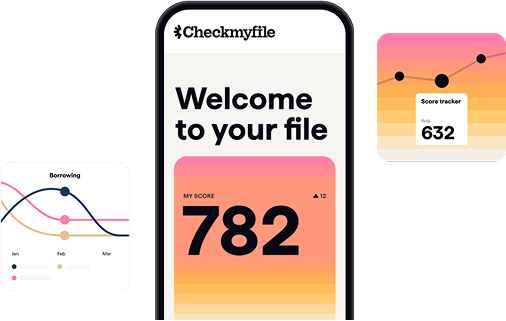
Lenders rarely look at just one score; they compare data across multiple agencies. To get the most accurate picture of your mortgage options, we recommend viewing your multi-agency report from Checkmyfile. Start your 7-day FREE trial today (£14.99/month after trial, cancel anytime).
We may earn a small commission from some links on this page, but we only recommend services we genuinely trust to help our clients.
FAQs: Getting a mortgage with a CCJ
A County Court Judgment (CCJ) is issued if you fail to repay a loan or debt. Both individuals and companies can receive a CCJ.
- It’s a legal record showing:
- The amount you owe
- Whether you must pay in full or in instalments
- Who you must pay
- The payment deadline
You can avoid a CCJ by responding to the claim form and explaining your financial situation.
You can prevent a CCJ from appearing on your credit file by paying the debt in full (including interest and court fees) within 30 days.
If a CCJ is added in error, you can have it removed by asking the creditor to notify the credit agency with proof of the mistake. Once the credit agency receives the correct documentation, the CCJ should be removed from your file.
A CCJ stays on your credit report for 6 years [3] from the date it was registered.
- Satisfied CCJs (paid in full) remain for the full 6 years but are seen more favourably by lenders.
- Unsatisfied CCJs (unpaid) are also removed after 6 years.
The older a CCJ is, the less impact it usually has on your mortgage application.
When a court issues a CCJ, it will send you a judgment showing:
- How much you owe (including any court or legal fees)
- Who to pay (usually the creditor or their representative, not the court)
- When and how to pay
If you’re experiencing financial difficulties, the court may allow you to pay in instalments. Paying off a CCJ can significantly improve your chances of being accepted for a mortgage.
After paying a CCJ, the creditor should notify the court and send you confirmation. It can take a few weeks for this to appear on your credit report.
If it hasn’t updated, contact the court with your proof of payment. They can issue a certificate of satisfaction to show lenders while your report is corrected.
Some lenders will consider applicants with CCJs, but decisions depend on the age and amount of the judgment. Recent CCJs are usually declined by most high street lenders.
Specialist lenders focus on applicants with CCJs, often with specific criteria. Using a bad credit broker can help you access these options. Examples of recognised specialist lenders include:
- Precise
- Pepper Money
- Aldermore
- Bluestone
Lenders consider both the age and amount of a CCJ. Some may be more flexible if:
- The CCJ is over 2 years old
- It was for less than £1,000 in the last year, or £2,500 in the year before that
A larger deposit can also improve your chances with lenders.
One or more CCJs can limit how much lenders are willing to offer. Older CCJs have less impact, while recent or unsatisfied CCJs carry more weight. A larger deposit can improve your borrowing potential.
Ignoring a CCJ means it will stay on your credit record as unsatisfied for six years. It can also lead to enforcement action, such as bailiffs or a charge on your property.
CCJs are public record and appear on your credit report. Lenders will consider:
- The amount owed
- How much time has passed
- Whether the CCJ is marked as ‘satisfied’
CCJs are classed as public information, alongside bankruptcies and Individual Voluntary Arrangements (IVAs). Lenders use this, together with your credit account information, to assess the risk of lending to you.
With 16.6 million people in the UK having experienced adverse credit at some point, and 15% of homeowners with prior adverse credit reporting a CCJ, lenders’ caution is understandable [1].
References
- Pepper Money (2024) Specialist Lending Study: Autumn 2024 Edition.
Available at: https://www.pepper.money/file/Specialist-Lending-Study.pdf
(Accessed: 13 January 2026). - Registry Trust (2025) Q3 2025 Statistics.
Available at: https://www.registry-trust.org.uk/stats/q3-2025-statistics/
(Accessed: 13 January 2026). - Experian (no date) County court judgments and your credit file – How long does a CCJ stay on your credit report?
Available at: https://www.experian.co.uk/consumer/guides/ccjs.html
(Accessed: 13 January 2026).
About the author

Phil Scott: Director
Phil Scott is the Founder and Managing Director of The Mortgage Centres, one of the UK’s leading independent, whole-of-market mortgage brokerages. With over 30 years of experience and a network of specialist branches, Phil has built a firm defined by manual advocacy and comprehensive market access.
Under his leadership, The Mortgage Centres provides high-touch advisory services for the full spectrum of UK borrowers – from standard residential moves for first-time buyers to complex specialist lending for portfolio landlords. Phil’s institutional approach ensures that every client receives a level of scrutiny and lender access that automated platforms cannot match.
Qualifications:
- FCA Regulated: Leading compliant, high-trust advice since 1992.
- Financial Planning Certificate: 1, 2 & 3 | Year Attained: 1992
- Certificate in Mortgage Advice and Practice (CEMAP) | Year Attained: 2001
Let's talk
Our team will aim to get back to you within 24 hours.
0330 0945876 local rate.
[email protected]
"*" indicates required fields